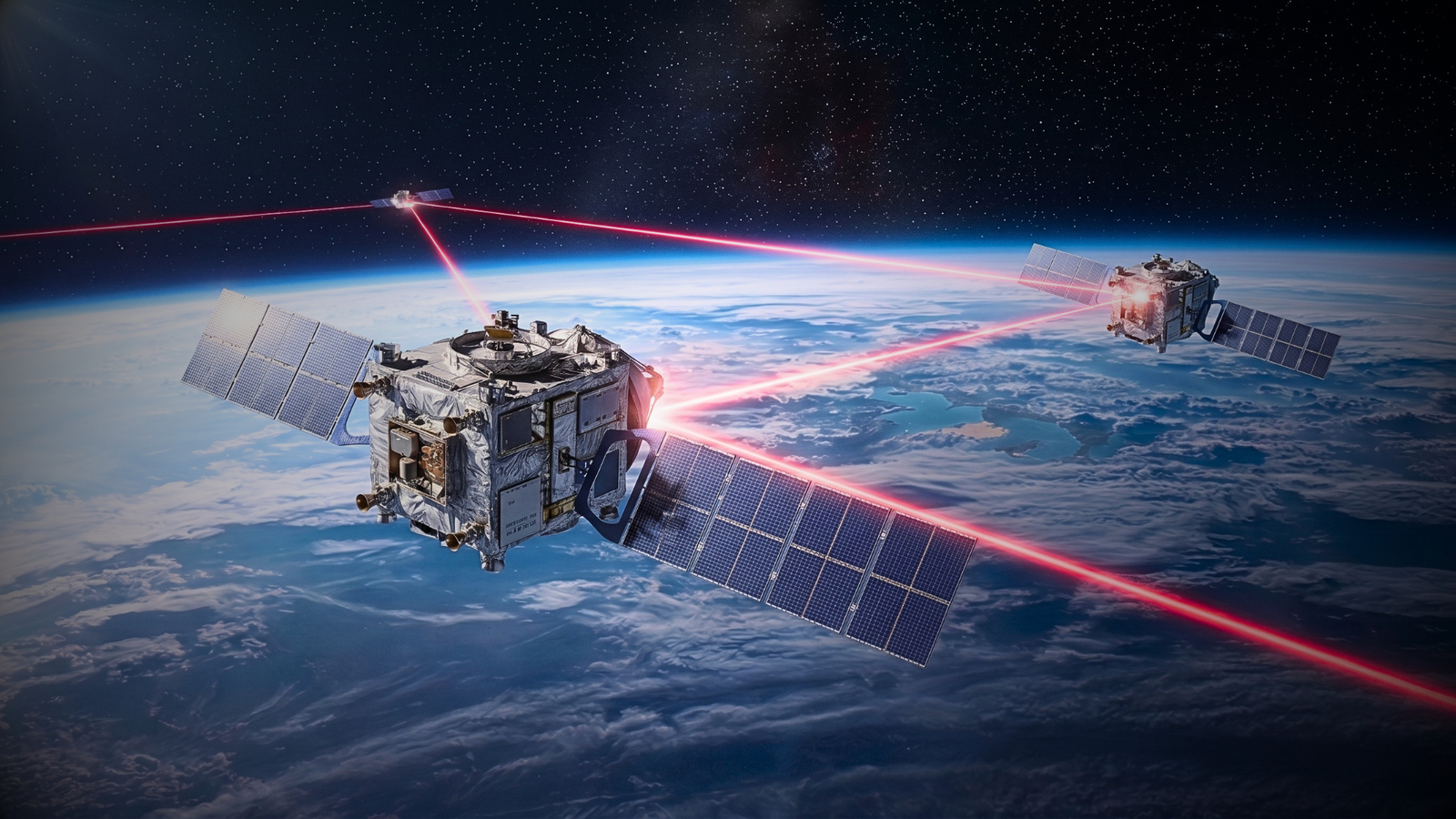
On August 13, the Space Force awarded five companies about $12 million each to prove their satellites can talk to one another and to the backbone of its emerging Space Data Network, the military's planned network of networks for moving sensor data to shooters. The vendors, Rocket Lab, York Space Systems, Northrop Grumman, Lockheed Martin, and Amazon LEO for Government, will each build Space Exchange Point satellites, on-orbit routers that plug commercial and military constellations into a single mesh. Most of the coverage framed the awards as an acquisition move to keep one company from dominating the network. They are also a decision about how much of the military's space architecture now depends on many vendors implementing the same interfaces correctly.
What the awards buy
The awards follow a roughly $2.29 billion agreement handed to SpaceX in May to build the SDN Backbone, formerly called MILNET, on militarized Starshield satellites operating as an optical mesh. That backbone is meant to knit together the Space Development Agency's transport and missile-tracking layers with traditional military satellite communications, and to feed Golden Dome and the Pentagon's CJADC2 command-and-control effort by shortening the path from a missile-warning sensor to an interceptor. The August awards add the connective hardware. Space Systems Command described the goal as a repeatable, secure baseline built on rigorous physical, electrical, and data interface standards, with vendors demonstrating high-speed optical routing on orbit.
Where interoperability becomes the attack surface
Standardized interfaces are what let a Rocket Lab satellite hand traffic to an Amazon one and both reach the SpaceX backbone. They are also a shared dependency. A weakness in the common interface specification is not one vendor's problem; it is a property of every node that implements it. Each Space Exchange Point sits where traffic from different operators and trust levels meets and gets routed, which makes every one of them a point worth attacking. The more constellations that plug in, the more places an attacker can look for a single implementation that got the spec slightly wrong.
The Space Force appears to understand the tradeoff. Its own list of deliverables for the August awards puts security protocols alongside standardized interfaces and digital models, and it has said it wants secondary suppliers partly to avoid single-source vulnerabilities in the backbone. Those secondary suppliers still have to match the Starshield laser mesh's interoperability requirements to connect at all, which keeps the hard problem in view: the same protocol conformance that makes the network work is what has to be secured across every vendor that joins it.
Space Force budget documents point to 13 SDN satellites in fiscal 2026 and 21 in fiscal 2027, with SpaceX due to deliver an operational backbone prototype by the end of 2027.
News first reported by Breaking Defense, with award details from Space Systems Command and Air & Space Forces Magazine.