Spain's defense satellite operator Hisdesat signed a contract on 31 July 2026 with Airbus Defence and Space and Thales Alenia Space to build SpainSat NG III, a secure military communications satellite whose defining feature is how hard it is to jam, spoof, or take offline. The order fills a hole in a programme the Spanish government has funded to the tune of roughly €2 billion, replacing SpainSat NG II, which Hisdesat wrote off in January after a millimetric space particle struck it during the climb to geostationary orbit.
Engineered against electronic warfare
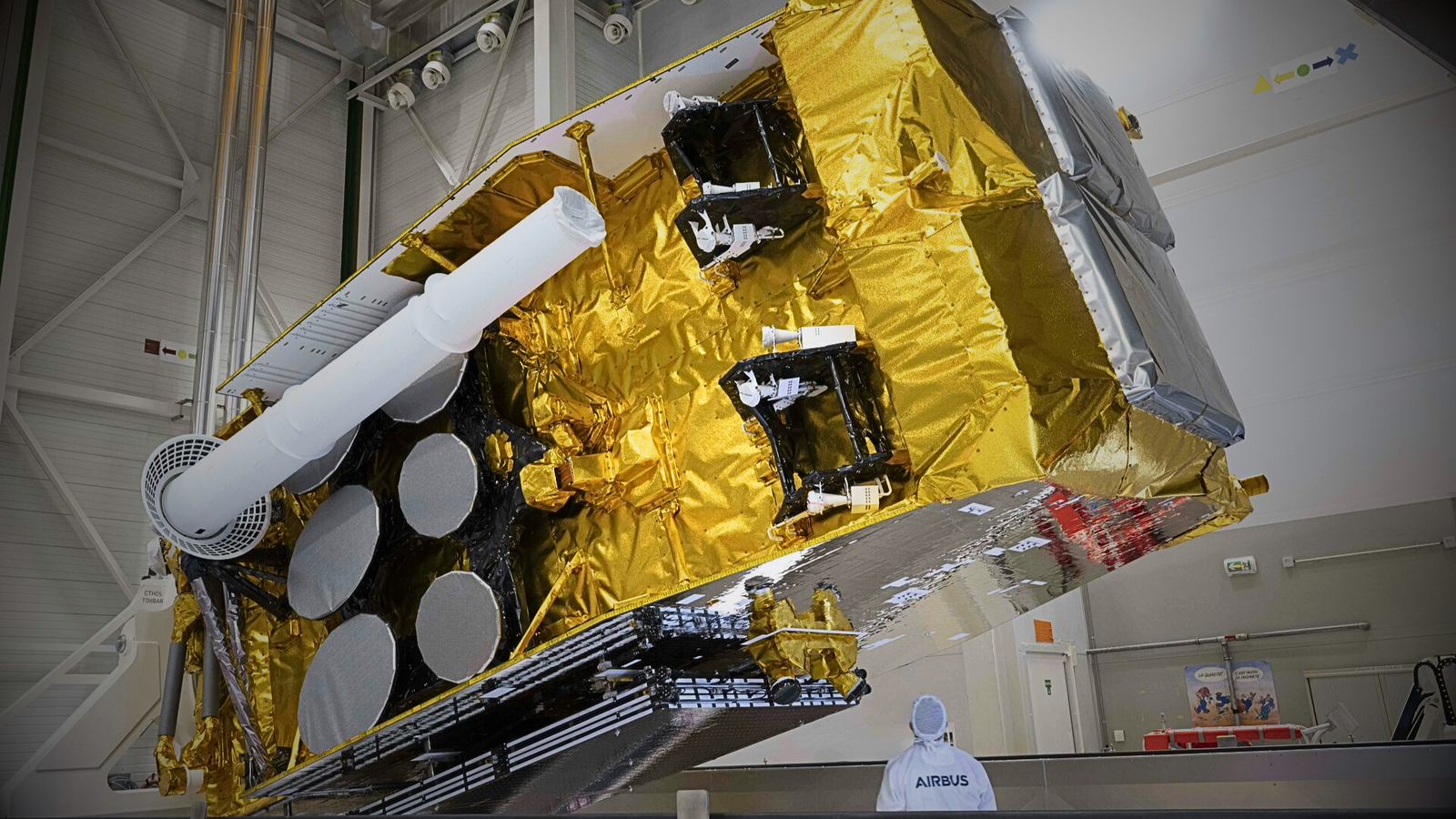
The security case for SpainSat NG III sits in its payload. It carries encrypted command-and-control links across X-band, military Ka-band, and UHF, engineered to counter active jamming and spoofing to NATO standards. The centerpiece is an active X-band antenna that does the work of 16 fixed antennas and can reshape its coverage up to 1,000 times a second, so operators can pull capacity away from a source of interference and toward the users who need it while the jamming is under way. Thales Alenia Space in Spain leads the UHF and military Ka-band payloads. The satellite is also hardened to survive high-altitude nuclear effects and electromagnetic pulses.
Replacing a satellite lost to space debris
SpainSat NG II reached orbit on a Falcon 9 in October 2025, then took a millimetric hit while maneuvering above geostationary altitude, around 50,000 kilometers up. On 16 January 2026 Hisdesat concluded the damage was non-recoverable and moved to procure a replacement, with the satellite insured against the loss. Its twin, SpainSat NG I, launched in January 2025 and finished in-orbit activation that September, and had been due to enter joint service with NG II in spring 2026. With NG III in the fleet, coverage from the pair will again reach from the Americas across Europe, Africa, and the Middle East and as far east as Singapore, roughly two-thirds of the globe, serving the Spanish Armed Forces, NATO, and the European Commission through the EU's GOVSATCOM programme.
Built largely in Spain
The SpainSat NG payloads were built by Spanish industry, and more than ten Spanish companies are contributing to NG III. The reconfigurable active antennas that give the satellites their agility came out of Pacis 3, a partnership between ESA and Hisdesat run under ESA's ARTES telecommunications research programme with support from the Spanish Space Agency. Airbus will design, integrate, and test the satellite in Spain, keeping the sensitive parts of a sovereign communications system inside the country that depends on it, which is the practical meaning of the strategic autonomy language that runs through the programme.
SpainSat NG III is due to launch in the third quarter of 2030 and enter service in early 2031, on a 48-month build and a planned 15-year operational life. Hisdesat has said it will be the most capable of the three satellites, with expanded bandwidth and stronger protection against jamming and electronic warfare than either predecessor.
News first reported by Airbus, Thales Alenia Space, and SatNews, with additional reporting from The Defense Post and Data Center Dynamics.