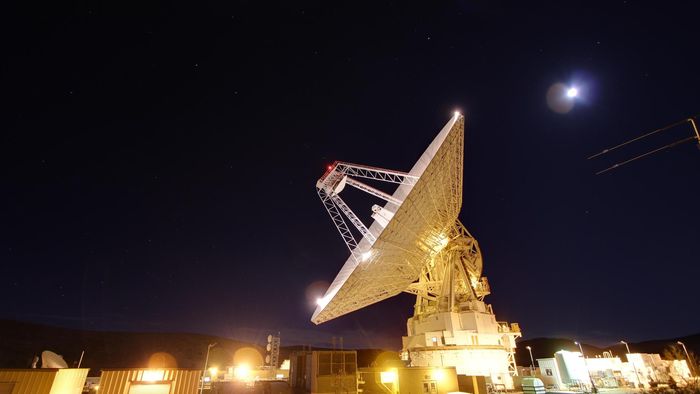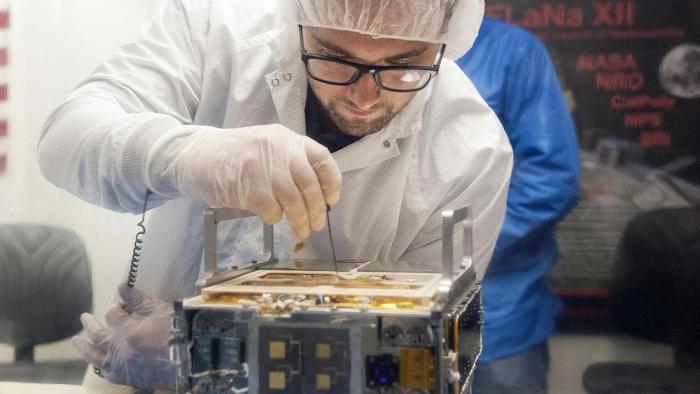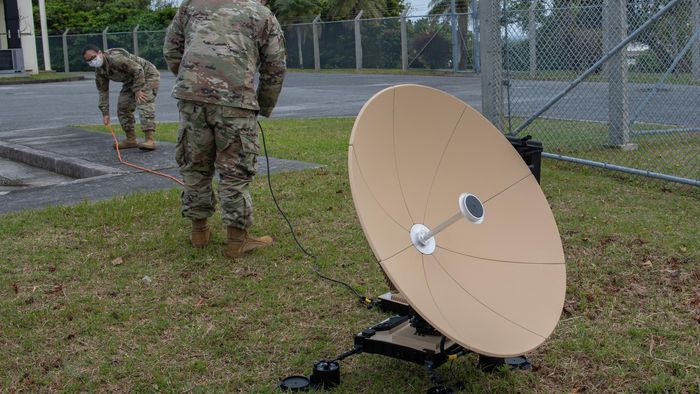

U.S. Space Command wants to stop running satellite operations through a handful of fixed ground stations. Speaking at the Space and Missile Defense Symposium in Huntsville on August 12, SPACECOM commander Gen. Stephen Whiting called for spreading the military's ground architecture across a distributed, mobile network, after Iranian strikes on U.S. radar and ground sites exposed how fragile single-node infrastructure has become. The resilience argument is sound against missiles. Against a network intrusion, distributing the ground segment cuts the other way.
The ground segment is where attacks land
Most attacks on space systems never touch the satellite. The ground station is the command hub. It holds operator credentials, issues the commands a spacecraft executes, and receives the data it sends back. A satellite built to the highest standard can still be lost through one poorly secured ground station, which is why researchers who study the commercial space sector consistently name the ground segment and its radio links as the primary attack surface. The clearest case is still the February 2022 assault on Viasat's KA-SAT network, where attackers reached a misconfigured VPN, pushed AcidRain wiper malware to tens of thousands of modems across Europe, and cut service to Ukrainian users as Russian forces crossed the border. No satellite was harmed. The ground did the damage.
Proliferation answers a kinetic problem
Whiting's proposal borrows directly from the logic that reshaped the orbital layer. The Space Force spent recent years moving from small numbers of large satellites in geosynchronous orbit to proliferated low-Earth-orbit constellations, on the theory that a large, redundant fleet is harder to knock out. He argued the ground layer needs the same treatment. A companion SPACECOM planning document, the Space Warfighting Environment 2040, calls ground systems the "physical anchor of spacepower" and warns that static, centralized nodes become single points of failure an adversary can hit through cyber intrusion, directed energy, precision fires, or sabotage. Its recommended fix is a mobile, distributed network that blends military, commercial, and coalition capacity and leans on cloud-native infrastructure.
Distribution and intrusion are different kinds of resilience
That fix trades one weakness for another. Spreading operations across many sites, commercial providers, and coalition partners does make the ground layer harder to destroy with a missile. It also multiplies the number of places an attacker can try to get in. Every added node is another set of credentials, another remote-access path, another patch cycle. Cloud and Ground-Station-as-a-Service models, which providers such as Amazon and Microsoft already sell, sharpen the trade. They let operators uplink and downlink through shared, cloud-native interfaces, but they bring shared tenancy, external APIs, and a wide gap in security maturity between well-funded government providers and smaller operators that may expose legacy protocols never designed to face the public internet. Distribution defends against a bomb. It does not, on its own, defend against a stolen password.
None of this argues against distribution. It argues that the security controls have to scale with the footprint. Segmentation, strict privileged-access management, zero-trust authentication between nodes, and continuous monitoring stop being optional the moment control is spread across a network the operator does not fully own. That, not the antenna count, is what determines whether a distributed ground segment ends up more resilient or simply more exposed.
News first reported by Air & Space Forces Magazine from the Space and Missile Defense Symposium in Huntsville.