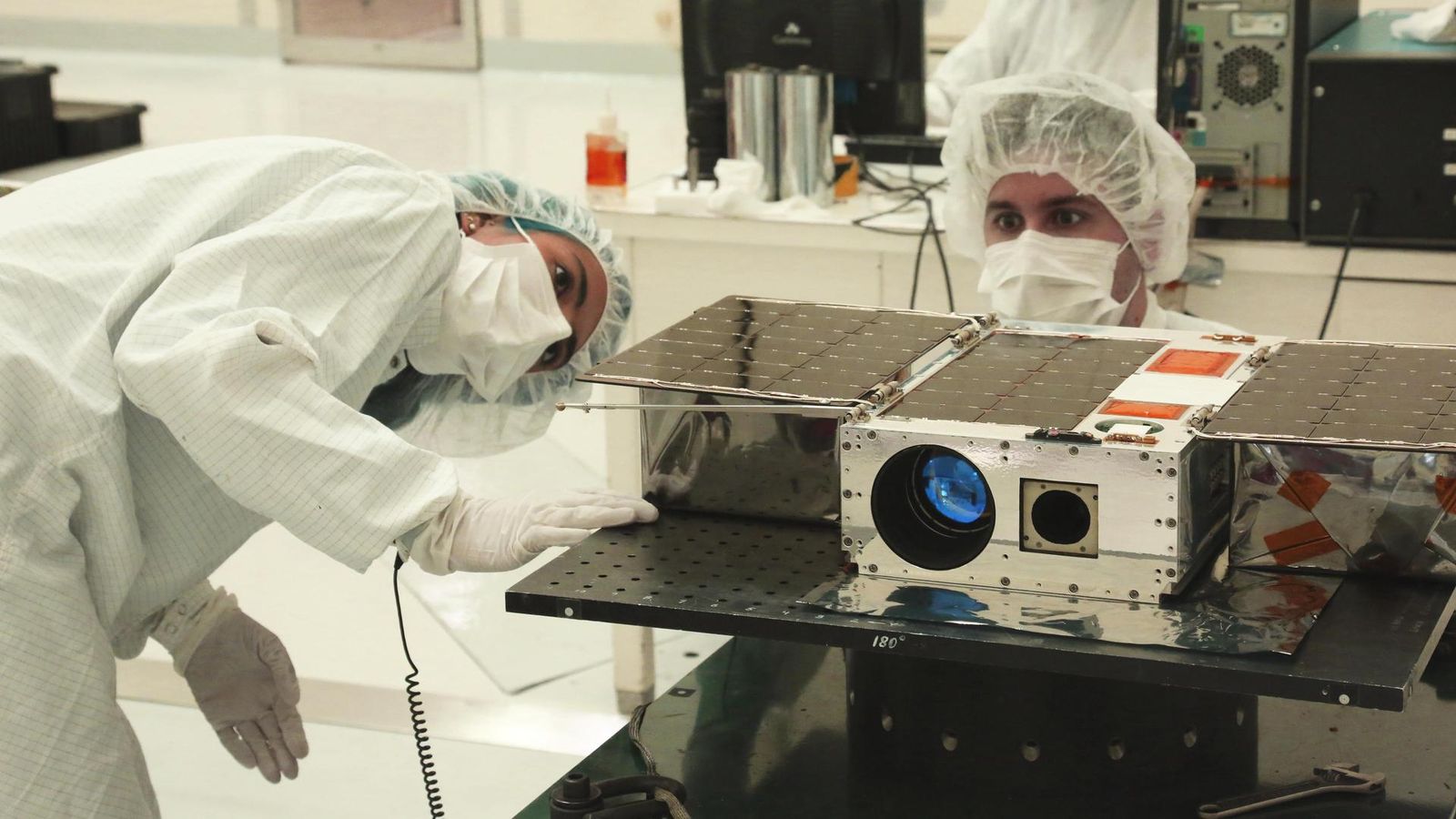
The European Space Agency's CyberCUBE, a 3U CubeSat built as an orbiting cybersecurity test lab, reached low Earth orbit on July 7, 2026, aboard a SpaceX Falcon 9 carrying 81 payloads on the Transporter-17 rideshare mission from Vandenberg Space Force Base in California. It is ESA's first satellite designed from the outset to run live cyber-defense experiments in orbit, trading the controlled conditions of a ground testbed for real radio interference, orbital dynamics and signal delay.
A Romanian-led first for ESA
GMV's Romanian subsidiary led CyberCUBE through its entire life cycle, from design and development through launch, commissioning and the handover of operational control to ESA, according to a GMV press release. It is the first ESA mission led end to end by a Romania-based company. "We have demonstrated that Romanian experts can lead an ESA mission from start to finish," said Cristian Chitu, GMV Romania's space director. Massimo Panzeri, who manages cybersecurity accreditation for ESA's Security Office, called the project a point of pride for the agency. Spanish manufacturer Alen Space built the 3U CubeSat bus, with GMV's Spain office supporting mission operations alongside the Romanian team.
A satellite built to be attacked, safely
CyberCUBE flies in a sun-synchronous polar orbit around 590 to 600 kilometers up, inclined 97.7 degrees, carrying a reprogrammable field-programmable gate array, a software-defined radio, an S-band transponder and an onboard camera, according to orbital tracking data from nanosats.eu. ESA has committed to at least a year of operations, long enough to cycle through several rounds of experiments before any decision on a follow-up mission.
The payload is built to host attacks against itself. Planned work, laid out in ESA's CyberCUBE experiments capabilities overview, includes detecting and blocking unauthorized commands aimed at the satellite's attitude control or propulsion systems, identifying radio-frequency jamming and GPS spoofing patterns and testing software to counter them, and running in-orbit field trials of post-quantum cryptographic algorithms. The onboard camera doubles as a sensor for threat-identification experiments, and the FPGA lets ESA swap in new detection logic without a hardware refresh.
ESA opens the lab to outside researchers
ESA is now running a call for ideas, inviting universities, companies and independent researchers to propose experiments that will actually execute on CyberCUBE while it remains operational, spanning intrusion detection, AI-based anomaly detection, resilience mechanisms, secure data transmission and satellite authentication. Selected proposals get access to a flying testbed instead of a ground simulator, a resource that has been scarce in European space-cybersecurity research.
Closing the gap between simulation and orbit
Most spacecraft cyber-defense validation still happens on the ground, on digital twins and hardware-in-the-loop rigs that cannot fully reproduce orbital radio conditions or adversarial timing. A similar push to close that gap is underway in the United States, where the Aerospace Corporation demonstrated its SpaceCOP onboard intrusion-detection system at DEF CON 34 this year, building on a prototype first flown aboard the Slingshot-1 CubeSat in 2022 and now available in an open-source version for NASA's Core Flight System. CyberCUBE gives ESA a comparable in-house capability, built and operated entirely by European industry.
CyberCUBE shared its Falcon 9 ride with 80 other payloads on Transporter-17, a manifest that included wildfire-detection sensors, 3D-printing demonstrators and several military technology experiments, according to Spaceflight Now's coverage of the launch.
First reported by the European Space Agency and GMV, with launch details confirmed by SatNews and Spaceflight Now.